Reversed Pollen
Selective Pollen Production: The Complete Guide to Reversing Plants
Reversing plants to obtain self-pollinating or crossed female-only lines is a cornerstone of modern horticulture. Using a professionally prepared Silverthiosulfate (STS) solution allows you to induce male flower formation on genetically target plants. The resulting pollen produces genetics that results 99.9% female offspring. By maintaining clean controls, these genetics remain highly stable and carry no greater risk of hermaphroditism than the parent lines.
The instructions below outline the precise preparation and application protocols originally described by Robert C. Clarke, optimized for modern home breeding. This guide details stock solution preparation, dilution, application schedules, and long-term pollen preservation.
Stock Solution Preparation
To ensure chemistry remains bioactive and shelf-stable, prepare two separate concentrated stock solutions. Part A and Part B should always be stored in cool, dark environments (such as a refrigerator) and kept in brown amber glass or opaque plastic bottles.
Compounding Part B (Silver Compound)
- Measure 500ml of pure distilled water into a clean, sterile container.
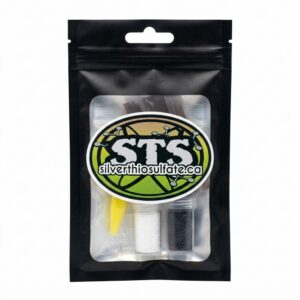
- Add the pre-measured Part B powder.
- Gently stir the Part B powder into the 500ml of distilled water until completely dissolved.
- Decant the solution into a tightly sealed amber glass container. Label clearly as “Part B – Stock Solution”.
- Rinse your measuring vessel and mixing utensils thoroughly with distilled water before proceeding.
Compounding Part A (Thiosulfate Compound)
- Measure 500ml of pure distilled water into a clean container.
- Add the pre-measured Part A powder.
- Stir the Part A powder into the 500ml of distilled water until fully dissolved.
- Decant into a tightly sealed amber container. Label clearly as “Part A – Stock Solution”.
- Clean and rinse all utensils with distilled water.
Mixing and Diluting the Working Solution
To create the active spraying solution, you must combine the stock solutions in a specific order to prevent the active reagents from precipitating out of solution. The final mixture must be diluted 1:9 with distilled water for safe plant application.
- Using a clean syringe, measure 50ml of Part A stock solution and dispense it into a glass measuring vessel.
- Rinse the syringe thoroughly with distilled water (or use a fresh, clean syringe).
- Measure 50ml of Part B stock solution.
- Crucial Step: While rapidly stirring/whisking the Part A solution, slowly inject the Part B solution into the vessel over a period of 10 to 30 seconds.
- Transfer the concentrated mixture into a 32oz (approx. 1 Liter) amber spray bottle.
- Add 900ml of distilled water to dilute the solution, leaving a small amount of headspace.
- Add a few drops of a natural surfactant (such as yucca extract or organic soap) and shake gently.
- Test spray a leaf: if the liquid beads and rolls off, add a tiny bit more surfactant until the spray wets the leaf surface evenly.
Application Protocols and Spraying Schedules
To successfully reverse flowers, apply the diluted working solution until the target branches and developing node junctions are thoroughly saturated.
Primary Schedule (5-Day Protocol)
- Perform the first spray application 5 days prior to changing the light cycle to flowering photoperiod (12/12).
- Repeat the application every 5 days until fully formed male pollen sacs begin to develop.
Alternative Protocol A
- Apply the first spray 14 days prior to transitioning to the flower cycle.
- Apply a second spray on the day the photoperiod is shifted to 12/12.
Alternative Protocol B
- Apply a single thorough spray application on the day the photoperiod is changed to 12/12.
Note: If you notice localized foliage burn or yellowing, dilute your working solution further (e.g., adding more distilled water to achieve a 1:12 or 1:15 ratio) to suit sensitive cultivars.
Advanced Pollen Management & Preservation
Working with Clones
For maximum safety and efficiency, run clones of your target plant. Reserve one clone specifically for pollen production in an isolated environment. Once harvested, use this pollen to pollinate a separate, untreated clone of the same plant or another target female.
Environmental Control and Containment
Pollen travels easily. Always use HEPA or carbon filters on both intakes and exhausts of your breeding tents. To prevent cross-contamination and health issues (as some growers develop sensitivity to pollen over time), spray the air down with RO or distilled water after handling plants to drop airborne pollen. Wash down tent walls with water after the cycle to neutralize residual pollen.
Pollen Dilution
Raw pollen is extremely potent. To avoid waste, dilute harvested pollen at a 1:50 ratio using thoroughly dried flour or cornstarch. This allows even application and easy visualization of pollinated sites.
Precision Application
Use a small, clean cosmetic brush to paint the diluted pollen onto target white pistils. This localized application prevents accidental pollination of adjacent branches, allowing you to produce genetics on select branches while leaving others genetic-free.
Long-Term Cryogenic Storage (Up to 10+ Years)
To keep pollen viable for years, it must be completely dehydrated before freezing.
- Dry a cup of uncooked rice in the oven at 150°F–170°F (65°C–75°C) for 12 hours. Place the hot rice in a sealable mason jar and allow it to cool to room temperature.
- Place your freshly collected pollen in an open foil cup or microtube inside the jar of dried rice. Seal the jar and let it dehydrate in a cool, dark cabinet for 7 days.
- Bake a small portion of flour in a pan until it turns slightly off-white/tan to remove all moisture. Cool in a separate sealed jar.
- Mix 1 part of the dehydrated pollen with 50 parts of the dry flour.
- Portion the mixture into 1.5ml airtight microcentrifuge tubes or heat-sealed foil pouches. Label each container with the cultivar lineage, date, and batch details.
- Store the labeled tubes inside a vacuum thermos bottle, and place the thermos in a deep freezer. The thermos acts as an insulator to protect the pollen from temperature swings during defrost cycles.
Troubleshooting Stubborn Cultivars
If a highly stable female plant resists turning or produces empty pollen sacs:
- Test different clones on different spray schedules.
- Follow up the standard STS schedule with a localized spray of 30-50 PPM colloidal silver solution 14–21 days into flowering.
- Harvest mature, unopened pollen sacs, dry them completely using the oven-dried rice method in a sealed jar, and then gently press the dried pods through a fine-mesh tea strainer to release the trapped pollen.
Reversal Spray">BUY STS SPRAY – FORMULATED BY SCIENTISTS!